The Flag and the Crown
On Banksy, Frode Lillesund, and the Blindness of Power
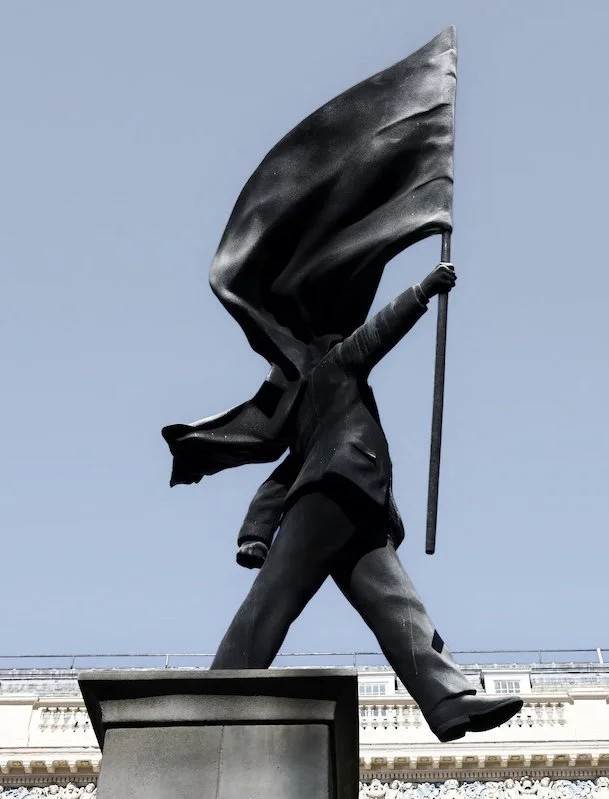
Banksy’s new statue in London is a bullseye. As public sculpture, it is brilliant in its immediacy — a visual slogan that strikes at once.
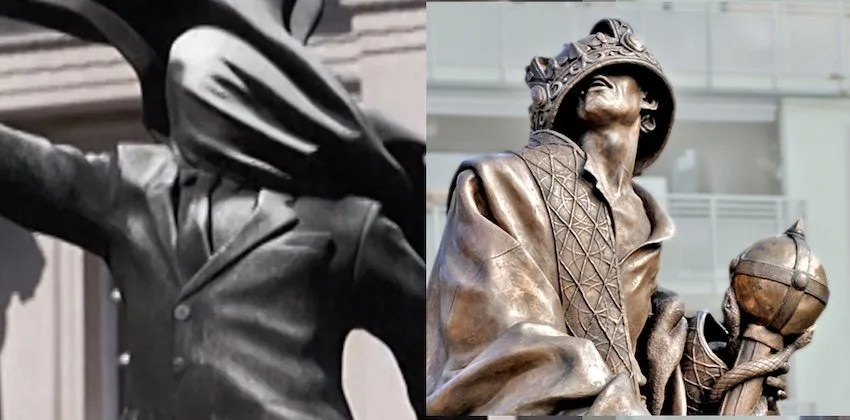
A suited man moves forward with a flag held high, but the flag simultaneously covers his face. He carries the symbol so closely that it blinds him. He no longer sees where he is going and literally marches off his own pedestal.
It is a simple image, and precisely for that reason it works. The work is not only about patriotism or nationalism, but about a more fundamental human mechanism: how power, identity, and self-understanding can become so tightly bound to a symbol that reality disappears behind it. The flag could just as easily be status, morality, ideology, or one’s own self-narrative.
Banksy places the figure among London’s classical monuments, as if it had always belonged there. That is precisely why the work becomes stronger: he uses the language of the monument against the monument itself. The figure looks like a hero, but reveals itself to be blind.
Banksy is strong when he works like this. He understands how an image can seize a moment immediately. As a graffiti artist, he built precisely this language: the quick gesture, the sharp satire, the visual slogan that enters public space without hesitation.
At the same time, there is also a limitation here. When the motif has already delivered its full meaning at first glance, there is less room for the slower experience — the one where the work continues to unfold after the message has already been understood.
Banksy touches something fundamental: the blindness that arises when a person identifies too strongly with power, role, or symbol. But this can also be read from another angle — not only as a critique of power “out there,” but as a more uncomfortable examination of our own need for illusion.
In The Emperor, it is not the flag that blinds the figure, but the crown. He carries power as a role he cannot fully inhabit. The crown is too large, the robe too heavy, and the entire body reveals the comic and tragic tension in trying to be greater than one truly is.
Here too, the language of the heroic monument is borrowed, only to be undermined from within. The figure stands on the pedestal as if he represents authority, but the body reveals something else: insecurity, blindness, and human insufficiency. He is not the hero on the throne, but a clown trying to fill a role he cannot master.
This is not only a critique of power, but of ordinary human falseness — the need to present oneself as more complete, more significant, and more indispensable than one actually feels. The figure is not primarily about leaders or public figures, but about something far more familiar: the life lie.
In the same way that Banksy’s man disappears behind the flag, The Emperor disappears behind the crown.
What connects these works is the relationship between power and blindness. The flag and the crown.
Banksy’s figure creates distance first and foremost. We see the powerful person from the outside — blinded by his own symbol, trapped in his own position. The satire works because it allows us to recognize the absurdity from a safe distance.
In The Emperor, something else happens. The figure invites not only criticism, but recognition. He is not merely a caricature of power, but an image of ordinary human falseness — the need to fill a role that compensates for one’s own insufficiency.
That is why the figure becomes more uncomfortable. He does not represent power “out there,” but points toward something much closer. The crown is not only his. It is ours too.
One work exposes power from a distance. The other makes it harder to place it safely outside ourselves. Both touch something essential — but from different directions.